Physical AI explained: how robots are starting to use foundation models
A plain-English primer on physical AI: how it differs from conventional industrial automation, what the new robot models do, and what to ask before piloting.
"Physical AI" is the label vendors now use for AI systems that perceive and act in the real world: robot arms, mobile robots and humanoids driven by the same kind of foundation models that power chatbots. The term is new, but robots are not. Understanding the difference between the two is the quickest way to judge whether a vendor claim is relevant to your operations.
Where robots stand today
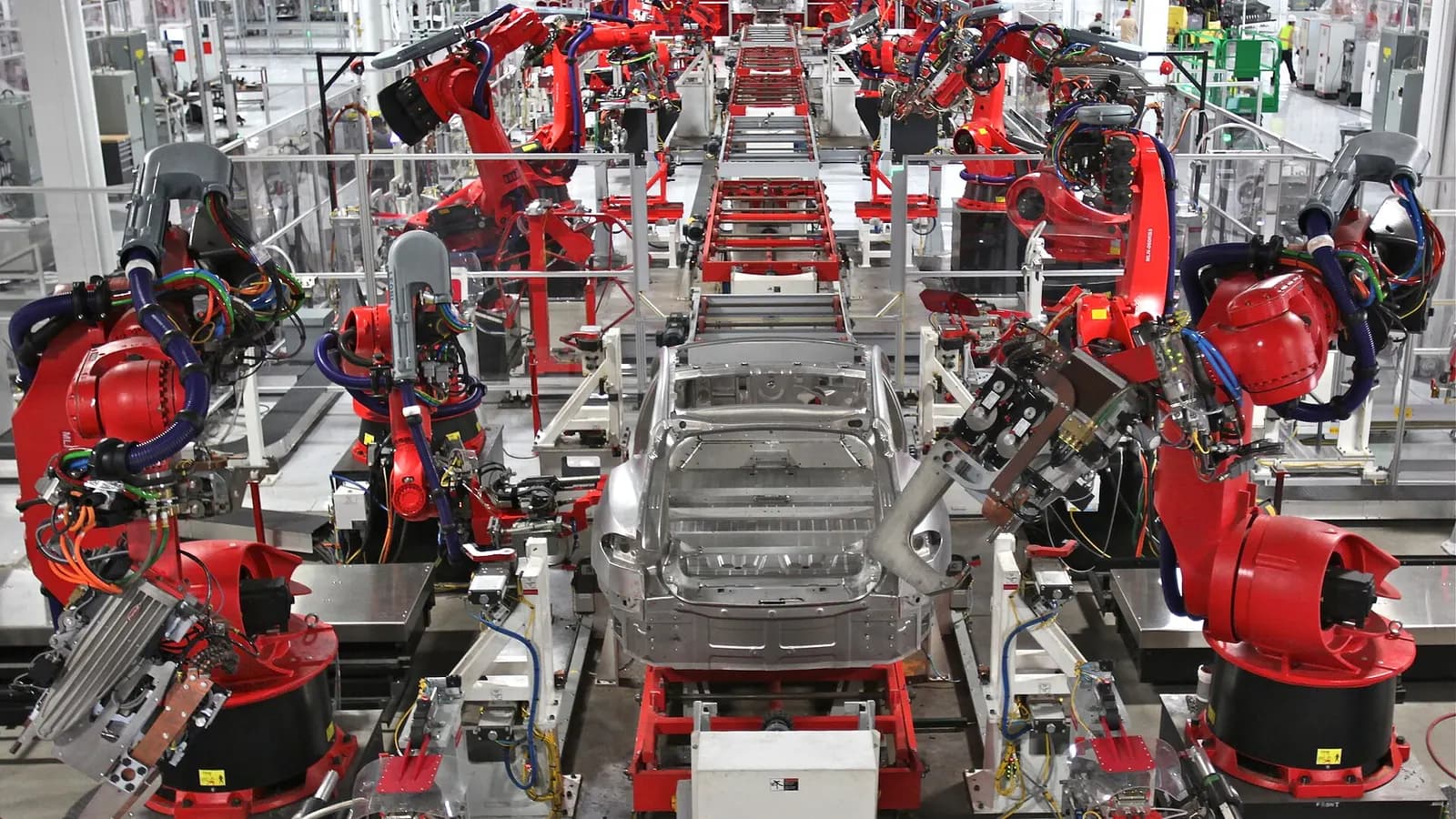
The International Federation of Robotics (IFR) reported about 542,000 industrial robots installed worldwide in 2024, more than double the figure from ten years earlier, with 4,664,000 units in operation at the end of the year [1].
These machines are overwhelmingly traditional automation. The IFR release does not describe them as AI-driven [1]. A welding or pick-and-place cell works because the part arrives in the same place every time and the path is programmed in advance. Change the part, the lighting or the position and a human reprograms it.
What is different about physical AI
Physical AI tries to remove that rigidity. The approach combines three ingredients.
A model that sees, reads and acts. Google DeepMind describes Gemini Robotics 1.5 as a vision-language-action (VLA) model: it takes visual input and an instruction and produces motor commands, can reason before acting, and can explain its steps in natural language [2]. It is also designed to transfer learned skills across different robot bodies [2].
A planning layer. A companion model, Gemini Robotics-ER 1.5, reasons about the physical world, plans multi-step missions, estimates progress and can call digital tools such as search. DeepMind describes it as the "high-level brain" that breaks a mission into steps and passes each to the action model as a natural-language instruction [2]. This planner/actor split mirrors how software agents are built.
Simulation and synthetic data. NVIDIA's Isaac GR00T platform is an open reference platform with a robot foundation model, data pipelines and simulation frameworks built on NVIDIA Omniverse and Cosmos [3]. Its models are described as cross-embodiment, trained on real, synthetic and internet-scale video data, and post-trainable for specific robots, tasks and environments [3]. Cited use cases include material handling, packaging and inspection [3]. NVIDIA's Jetson Thor hardware runs real-time inference and control [3].
Layer | Job | Example |
|---|---|---|
Reasoning / planning | Break a goal into steps, call tools | Gemini Robotics-ER 1.5 [2] |
Vision-language-action | Turn instructions and images into movements | |
Simulation and data | Generate training scenarios safely | Omniverse and Cosmos frameworks [3] |
Edge compute | Run models on the robot in real time | Jetson Thor [3] |
A concrete way to think about it
Imagine a packing station that handles mixed product shapes. A traditional cell needs a fixture or a program per item. A VLA-driven system is meant to be told "put the items from the tote into the box" and adapt to what it sees. The trade is flexibility for predictability: a learned policy can fail in ways a fixed program does not, and failures can be harder to trace.
Limits worth stating plainly
Availability is uneven. At release, the planning model was available to developers through the Gemini API, while the action model was limited to select partners [2].
Public sources show capability, not reliability. The vendor pages cited here describe what the models do and how they are structured; they do not give throughput, error rates or safety certifications for production use [2][3].
Safety is a separate engineering discipline. A model that plans well still needs guarded workspaces, stops and certified safety systems around it.
Questions to ask before a pilot
What happens when the model is wrong: does the robot stop, ask for help, or continue?
Which parts of the task are learned and which remain deterministic?
How is performance measured on your parts and your lighting, not a demo set?
What sensors and compute sit on the robot versus in the cloud?
Implication for businesses: physical AI is worth tracking for variable, low-volume handling tasks, but a first step should be a bounded pilot on one workstation with clear stop conditions and measured error rates. Existing programmed automation remains the right tool for stable, high-volume work.
Sources
- Global Robot Demand in Factories Doubles Over 10 Years International Federation of Robotics, 2025-09-25. ifr.org/ifr-press-releases/news/global-robot-demand-in-facto
- Gemini Robotics 1.5 brings AI agents into the physical world Google DeepMind, 2025-09-25. deepmind.google/blog/gemini-robotics-15-brings-ai-agents-int
- NVIDIA Isaac GR00T NVIDIA Developer. developer.nvidia.com/isaac/gr00t

.jpg)