AI in manufacturing and supply chain: what published data supports
Deloitte's executive survey and IFR robot counts give a modest view of AI in factories: strong intent, early deployment, and a human-heavy floor.
Manufacturing and supply chain are two of the most frequently cited targets for AI, and two of the hardest to assess, because vendor claims are plentiful and independent measurement is scarce. This post is deliberately modest: it rests on just two published sources, and everything below is limited to what they support: Deloitte's manufacturing outlook, built on a survey of 600 manufacturing executives, and the International Federation of Robotics' annual count of industrial robots.
Intent is high, deployment is early
Deloitte's outlook, published November 13, 2025, draws on its 2025 smart manufacturing survey of 600 executives. It finds that 80% plan to put at least 20% of their improvement budgets into smart manufacturing initiatives, mainly foundational tools: automation hardware, data analytics, sensors and cloud computing [1]. That ordering is informative. Executives are funding the data and instrumentation layer first, which is the prerequisite for most AI use cases on a plant floor.
On physical AI, meaning AI that perceives and acts through machines, Deloitte cites a Manufacturing Leadership Council survey from early 2025 in which 9% of manufacturers use it and 22% plan to within two years, more than double the share using it then [1]. The outlook says agentic AI adoption is likely to grow considerably, listing supply chain, workforce knowledge capture, production uptime and customer repair as areas where it can add value, but it gives no adoption percentage [1]. We read that as a signal that the evidence base for agents in this sector is still thin.
The floor stays human
Deloitte also cites an expectation that more than 81% of manufacturing task hours will remain human-driven, and more than a third of the 600 executives named equipping workers with smart manufacturing skills as their top concern [1]. For a buyer, the implication is that the realistic project is decision support and exception handling for people, not a lights-out plant.
Supply chain: the pressure is cost, not technology
The outlook's supply chain data is about uncertainty. In the National Association of Manufacturers' 2025 Q3 survey, manufacturers expected input costs to rise by an average of 5.4% over the next year [1]. A majority of trade professionals surveyed by the Thomson Reuters Institute (285 respondents, March 2025) said their companies already use technology to evaluate trade routes, identify risk, find cost savings and run scenario modeling [1].
Those are exactly the tasks language models and forecasting tools are suited to: reading supplier documents and shipping schedules, comparing scenarios, and flagging changes. The survey, however, reports technology use generally, not AI specifically, so it shows readiness more than measured results.
Robots are not AI, but they set the ceiling for physical AI
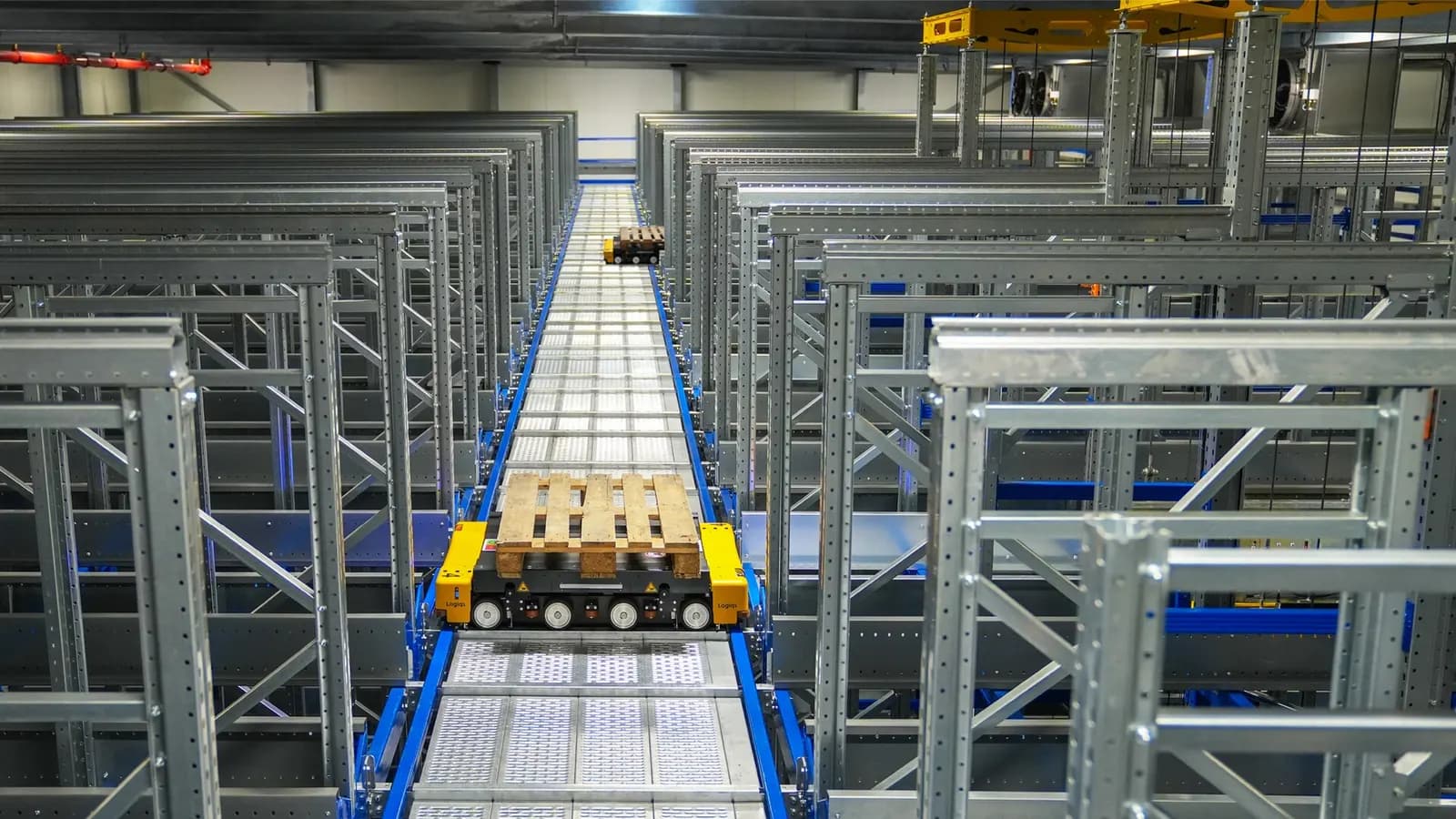
The IFR's World Robotics 2025 release counts 542,000 industrial robots installed worldwide in 2024, the fourth straight year above 500,000 units. The installed base reached 4,664,000, up 9% [2]. Physical AI deploys onto this base, so the installed base is a rough guide to where it can land first.
The IFR forecasts 575,000 installations in 2025 and more than 700,000 by 2028 [2]. Because most of these machines are traditional, programmed automation, physical AI will mostly depend on renewing and extending that installed base rather than starting from scratch.
A caution about "in production" claims
Cross-industry surveys show how quickly "deployed" can be stretched. LangChain's 2026 survey found 57.3% of respondents had agents in production, with customer service, research and internal workflow automation the leading use cases [3]; manufacturing-specific use cases are not broken out in the figures we reviewed. Take sector claims that cite a single large percentage with care, and ask what was measured.
What the evidence does not tell us
Neither source measures results: no yield gains, downtime reductions or inventory savings are reported in the material above, and we have not cited any. Both are also from 2025 and predate the model releases of mid-2026. If a vendor presents savings figures, ask for the plant type, baseline, time period and whether the figures are measured or modelled.
Practical implication
Fund the data and instrumentation foundation first, and pilot AI on document-heavy supply chain tasks such as supplier-risk review before committing to physical automation. Measure a baseline before the pilot starts so that any result can be checked.
Sources
- 2026 Manufacturing Industry Outlook Deloitte Insights, 2025-11-13. www.deloitte.com/us/en/insights/industry/manufacturing-indus
- Global Robot Demand in Factories Doubles Over 10 Years (World Robotics 2025) International Federation of Robotics, 2025-09-25. ifr.org/ifr-press-releases/news/global-robot-demand-in-facto
- State of Agent Engineering LangChain, 2026-06-12. www.langchain.com/state-of-agent-engineering